When you stay at Les Volets Bleus, you immediately sense that the "Catalan country" is more than a tourist label. Children learn Catalan at school, village fêtes happen in Catalan, and the senyera — the red-and-yellow striped flag — flies from windows as naturally as the French flag. Here are the keys to understanding.
In the beginning: medieval Catalonia
The story starts in the 9th century. Charlemagne creates the Marca Hispanica (Spanish March), a buffer zone between the Carolingian Empire and the Caliphate of Córdoba. This march is divided into counties, including the County of Roussillon, which covers today's Pyrénées-Orientales department.
Over the centuries, these counties unite around the County of Barcelona. This is the golden age of medieval Catalonia: a unique Romance language is spoken — Catalan; Romanesque churches of singular beauty are built; agricultural and merchant economies flourish.
The Kingdom of Majorca (1276-1349)
In 1276, on the death of James I of Aragon, the kingdom is divided. His son James II inherits a new Kingdom of Majorca uniting the Balearic Islands, Roussillon, Cerdanya and Montpellier. Its mainland capital is Perpignan.
This brief period (barely 70 years) leaves a deep mark. The Palace of the Kings of Majorca, still standing in Perpignan, testifies to the refinement of this court. The Conflent abbeys — Saint-Michel-de-Cuxa, Saint-Martin-du-Canigó — reach their peak.
In 1349, the kingdom returns to the Crown of Aragon. Roussillon stays Catalan until 1659.
The Treaty of the Pyrenees: 1659
On 7 November 1659, in the hall of Pheasant Island on the Franco-Spanish border, Mazarin and Don Luis de Haro sign the Treaty of the Pyrenees. France gains Roussillon, Conflent, Vallespir and part of Cerdanya — what we now call Northern Catalonia.
The border cuts some villages in two. Llívia, a Spanish enclave inside French territory, remains the most spectacular example. Yet the Catalan country stays culturally united: people keep speaking Catalan, celebrating the same saints, cooking the same dishes.
Catalan Romanesque art: an open-air treasure
The Pyrénées-Orientales hold an exceptional concentration of Romanesque churches and abbeys from the 10th-12th centuries. Within an hour of Prunet-et-Belpuig you can visit:
- Saint-Michel-de-Cuxa Abbey (Codalet): its crenellated square bell tower, a cloister whose pieces are now displayed at the Cloisters Museum in New York
- Saint-Martin-du-Canigó Abbey: nestled at 1,100 m, accessible only on foot (45 min climb), restored by the Beatitudes Community
- Serrabona Priory (Boule-d'Amont): its pink-marble carved tribune is one of a kind
- Sainte-Marie d'Arles-sur-Tech and its sarcophagus that miraculously produces water
- Chapel of the Trinity at Prunet: a 30-min walk from the cottage, founded in the 11th century
The Catalan language: alive and loved
Catalan is not a dialect — it's a full Romance language, born in the 9th century, spoken today by around 10 million people across Catalonia (Spain), Valencian Country, Balearic Islands, Andorra, Sardinia (in Alghero) — and the Pyrénées-Orientales.
In France, after a long decline (the Republic only taught French at school), Catalan has been thriving since the 1980s. Bilingual French-Catalan schools, immersive Bressola schools, and universities now teach the language. You'll hear it at the markets, in fêtes, and see bilingual road signs.
A few words to pick up during your stay:
- Bon dia — good day
- Adéu — goodbye
- Sí us plau — please
- Gràcies — thank you
- Visca Catalunya! — Long live Catalonia! (heard at festivals)
Saint John's fête and the sacred fire of Canigó
This is the Catalan tradition par excellence. Every 22 June, on the summit of Mount Canigó (2,784 m), walkers light a flame from kindling brought up throughout the year by Catalan villages from both sides of the Pyrenees.
This flame — the Foc de Sant Joan (Fire of Saint John) — is then carried on foot by relay runners to over 350 villages on both sides of the border, where it lights the bonfires of Saint John on the night of 23-24 June. It's the strongest symbol of Catalan unity.
If you stay at Les Volets Bleus in June, don't miss the lighting ceremony in Prunet-et-Belpuig or nearby villages. A night of music, sardanes (the traditional dance) and pastries (the coca de Sant Joan).
Catalan gastronomy: what to taste
Catalan cuisine blends Spanish, Mediterranean and mountain influences. Some essentials:
- Cargolade — snails grilled over embers with aïoli, the festive dish of village gatherings
- Boles de picolat — meatballs with olives and white beans
- Cuttlefish rouille — coastal speciality, try it in Collioure or Argelès
- Catalan cake — fruit and rum cake
- Crema catalana — cousin of crème brûlée, flavoured with lemon and cinnamon
- Naturally sweet wines of Roussillon: Maury, Banyuls, amber Rivesaltes
Catherine will happily share her favourite addresses in the surrounding villages, from bistros to Michelin tables.
5 places to feel the Catalan country
If you want to truly experience this Catalan identity during your stay, these five places are essential:
- Castelnou (25 min) — one of France's Most Beautiful Villages, its 10th-century viscount castle, cobbled lanes and craftsmen's workshops
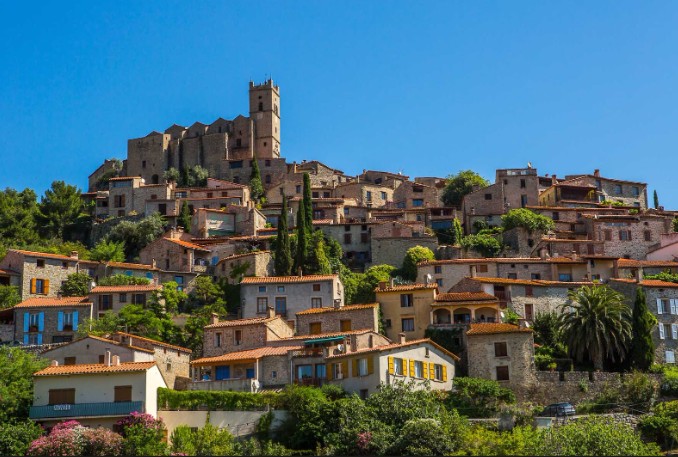
- Eus (35 min) — "the sunniest village in France", perched on its rocky spur, magical sunset light
- Céret (30 min) — capital of the cherry and city of art, frequented by Picasso, Matisse and Soutine, whose works are at the Museum of Modern Art
- Saint-Michel-de-Cuxa Abbey (40 min) — 9th-century Benedictine monastery, hosting the Pablo Casals festival each summer in July-August
- Perpignan (50 min) — historic capital of the Kingdom of Majorca, its Royal Palace, medieval centre, and Catalan-speaking festivals
A stay that becomes a journey
Coming to Les Volets Bleus isn't just renting a house. It's stepping into this thousand-year-old story, into a language that still sings at the markets, into traditions that beat on in the villages. Catherine, who learned to love this land while restoring the house with the already-blue shutters, will gladly share her addresses, her readings, her stories.
The Catalan country takes a little time to give itself: you have to take the slow winding roads, the morning markets, the long conversations in village bistros. But in return, it offers an intensity of experience that's rare in mainland France.
Visca Catalunya, i bona estada!